Pics from 2013 Chuckanut Writers Conference

Dear Writers: I was delighted to be back at the Chuckanut Writers Conference this year!
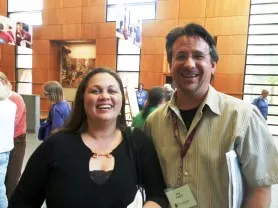
With Village Books Community Outreach Director Paul Hanson

At the 2013 Chuckanut Writers Conference in Bellingham WA with Village Books Community Outreach Director and fellow writer Paul Hanson.
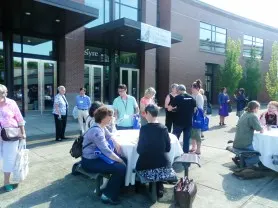
Gary Luke, Waverly Fitzgerald, Garth Stein, and Thor Hanson at the author book signing

Sasquatch Books Publisher Gary Luke and authors Waverly Fitzgerald, Garth Stein, and Thor Hanson at the author book signing.
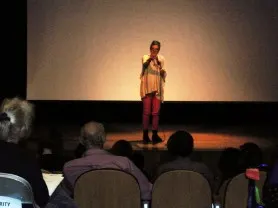
Naseem Rahka's plenary session speech about the Grand Canyon and the writerly life moved many people to tears.

Naseem Rahka’s plenary session speech about the Grand Canyon and the writerly life moved many people to tears.
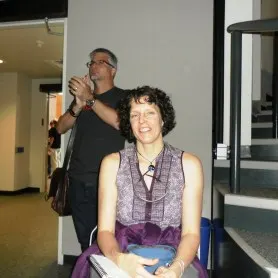
Panel Host and former Conference Organizer Nan Macy (with a slightly known writer seen in the background).

Panel Host and former Conference Organizer Nan Macy (with a slightly known writer seen in the background).

As you well know, there’s something special and unique about each writing conference and this one, co-hosted by Village Books and Whatcom Community College delivers its own mix of brilliant faculty, pitching opportunities, and plenty of chances for writers to mingle, including participating in evening open mics on day two of the conference.
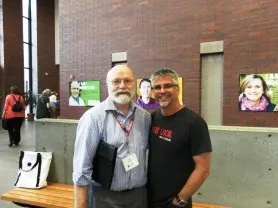
Chuck Robinson, co-owner of Village Books, and writer Garth Stein

Chuck Robinson, co-owner of Village Books, which co-sponsors the conference, and writer Garth Stein, this year’s keynote speaker.
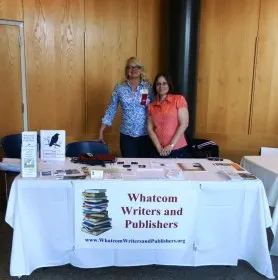
Kiffer Brown of Chanticleer Reviews and Amanda June Hagarty staff the Whatcom Writers and Publishers table

Kiffer Brown of Chanticleer Reviews and Amanda June Hagarty staff the Whatcom Writers and Publishers table.
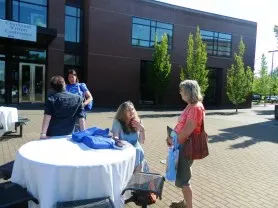
Suzanne Paola at the author book signing

Suzanne Paola, who spoke on writing the book proposal, talks to a writer at the author book signing.

Each of the three years of the conference, my role has been different: I was the Emcee the first time out, attended as a Faculty Member last year (read about my talk on storyboarding), and this year was invited back as a Special Guest Presenter to give a morning briefing on how to pitch (you can read the text of my talk in the post Pitching 101). It was truly heartwarming to have writers run up to me throughout both days to report that they’d “done what I said” and had a successful pitching experience. I felt like a proud mama! Continue reading

Pitching 101

Dear Writers: 

Here’s the text of a talk on how to pitch that I gave at this year’s Chuckanut Writers Conference in Western Washington.

(Source: tumblr via mademoisellearielle, via oddinclinations)

(Source: tumblr via mademoisellearielle, via oddinclinations)

I. What is pitching?

Pitching a project is not a singular effort. It’s an entire program that you create to develop a project and curate it from conception to publication—and then continue on to pitch to your reading audience. From the time you first decide to dedicate yourself to a project through the lifetime of the project, you will be pitching it.

The first person you have to pitch is yourself. Life is busy and there are many ways you can spend your time and many ways you can spend your writing time. When you decide to devote a significant amount of time to one project, you are choosing to make it a priority, likely setting aside or postponing other things you could be working on.

You make this choice because you believe wholeheartedly in the project. Ask yourself why you want to do this project and why you think it has viability in the marketplace. You need to have a clear grasp of that answer—if you don’t, then you haven’t evaluated carefully enough.

Further, you need to be able to articulate that reason in one or two sentences (not run-ons!). So doing will become the basis for shaping your vision of what the project will be and will function as part of the map for developing this vision to its fullest potential. And, those one or two lines can be the genesis of the pitch you later deliver to potential agents, publishers, and audiences.

Tip #1: Give yourself the task of writing in one or two lines your reasons for doing this project. It will help you reconnect with your original inspiration and excitement about the project. Remind yourself of these reasons every time you go to pitch.

Another way to say this is to tell the story of the project. Be able to describe succinctly how it came to be and why you believe in it. Let that build your confidence as you approach the agent or editor. Also, do not be surprised if the agents asks you that very question—What is the story of your project? It’s one of the first questions my agent asked upon signing me. Continue reading

Chuckanut Writers Conference Update from Chasse Gunter

Dear Writers:

Chasse Gunter, intern for this year’s Chuckanut Writers Conference, offered this guest blog to bring us up to date on conference details, so take it away, Chasse!

* * *

cwcYou know that point in time when something is closer than it is far away ? That time has come! The Chuckanut Writers Conference is only 50 days away! There’s only one thing closer than the conference itself—the Early Bird Discount deadline. In all situations, the early bird gets the worm, but in your case, the early bird gets a whopping discount, too! That price is $229 and all you have to do is register before May 15th. Don’t mark your calendar; just go grab a spot right now. Continue reading

February 2013 Open Mic @ Village Books + Alex!

Dear Writers:

???????????????????????????????

Alex from Village Books

Many of us have enjoyed the hospitality of the great folks at Village Books in Fairhaven, including the upstairs Book Fare Café and Paper Dreams alongside. Have you ever wondered what they do in their off time? Well, on a trip to Rustic Coffee Bar in Fairhaven with the coffee shop writer himself, a.k.a. Sean Dwyer, we encountered a very familiar face. Continue reading

Insider Scoop: 2013 Chuckanut Writers Conference

cwcDear Writers:

This year’s Chuckanut Writers Conference is right around the corner! Guess what, I have a bunch of insider information to leak in advance of the website going live later this month. Please don’t tell a single person about this—instead, tell everyone you know! Because it’s gonna be another great conference with an awesome lineup of authors, and I can’t wait to see you there.

WHO’S COMING: Alice Acheson, Bruce Beasley, Jeff Bender, Wendy Call, Karen Finneyfrock, Waverly Fitzgerald, Kathleen Flenniken, , Thor Hanson, Gary Luke, Frances McCue, Suzanne Paola, Brenda Peterson, Naseem Rakha, Natalie Serber, Jennie Shortridge, Elizabeth Kracht, and Mr. Art of Racing in the Rain himself, Garth Stein. Continue reading

Props To:

Dear Writers,

What are you and your characters doing today? I’m continually dazzled by the wonderful work people are doing in our region. Here are some that recently caught my attention!

Props To:
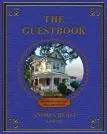
  • The multitalented Andrea Hurst for the release of her latest book, The Guestbook, available in paperback and e-book. Both a literary agent and published writer, Andrea lives and works in the Pacific Northwest, on an island much like the fictional Madrona of The Guestbook. How she carves out time to write amidst managing her many literary and business endeavors beats me, but way to go, Andrea!
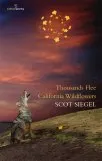
  • Poet and Community of Writers at Squaw Valley alum Scot Siegel on the release of his latest book of poetry, Thousands Flee California Wildflowers (Salmon Poetry, 2012). Scott lives in Oregon where he works as a town-planning consultant, serves on the board of the Friends of William Stafford, and edits Untitled Country Review. Hopefully, one day we’ll see him back in Bellingham, where he’s read before at Village Books. Find him at Red Room: www.redroom.com/author/scot-siegel/. Continue reading

Three-Act Structure Paradigm

Dear Writers,
I was delighted to again serve on the faculty of the Chuckanut Writers Conference last week in Western Washington. Here’s a snippet from a session I taught on how writers can draw from film storyboarding concepts to create a text-driven version of a storyboard. In this moment, the discussion centered on the three-act structure paradigm.

Let’s turn to our friends the screenplay writers for a moment. It’s some of their tools that we are borrowing and modifying to make our stories. Looking at conventional film structure is useful in gaining a better understanding of story action and plot points.

The conventional three-act structure looks like this:

In Act I, is the setup. The character(s), the action of the story, the problem or question of the story is established. Continue reading